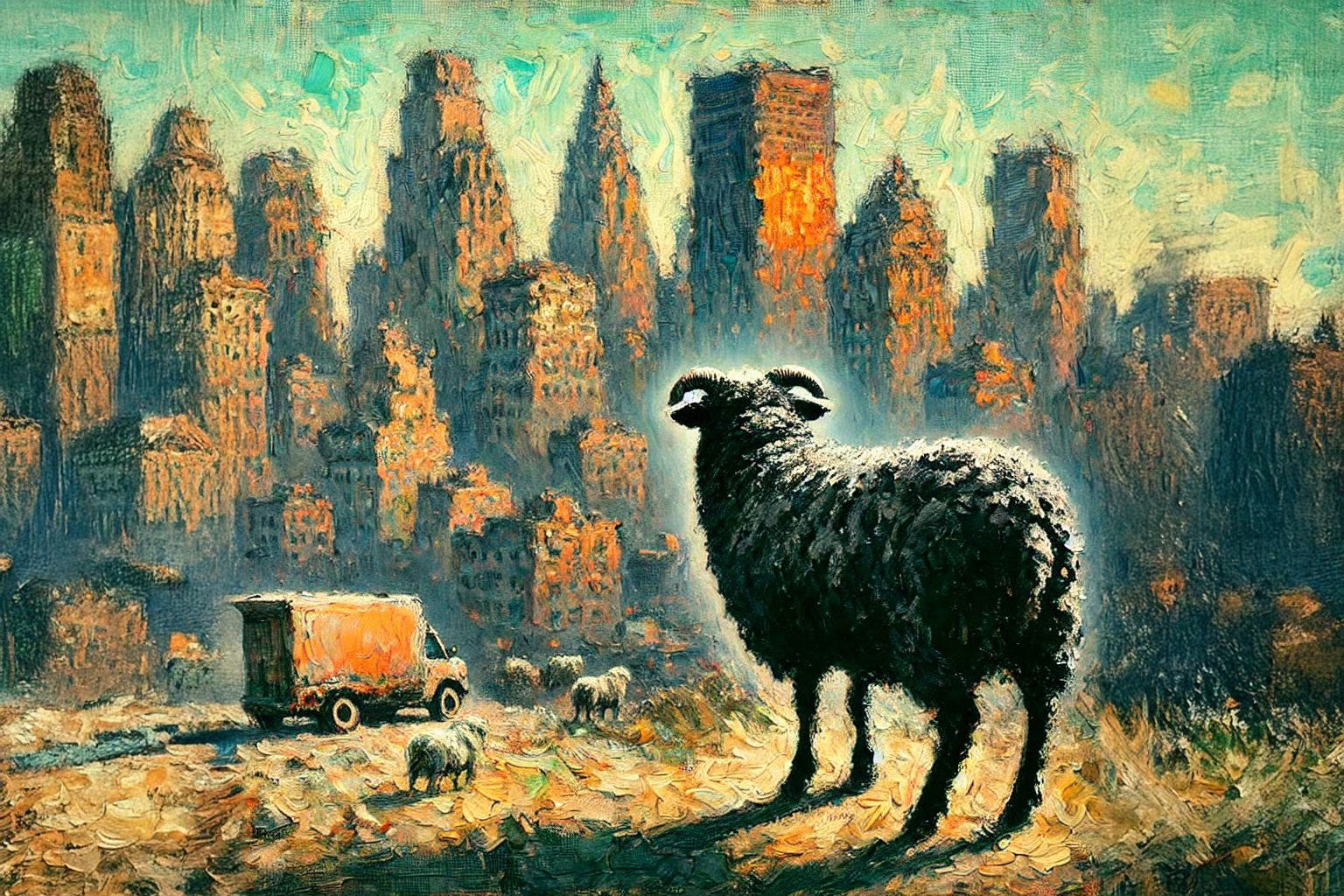
Everything Has Gotten Uglier
The deterioration of beauty explains our broken culture.
In the Holocaust survivor Victor Frankl’s classic book, Man’s Search for Meaning, he explains that one of the most important lessons he learned from his experience in a concentration camp was the need for beauty to continue living. He argued that creating beauty is not just about vanity, but is a gateway to finding meaning and purpose—especially when everything else is taken away. Beauty was one of the keystones for Frankl’s philosophy, known as Logotherapy.
Lately, I’ve been trying to figure out the disconnect between the relative prosperity that the Western world enjoys compared to previous generations, and the fact that it seems the majority of Westerners don’t actually enjoy it. My contention is that one of the main reasons for this is that there's less “beauty per capita” in the world.
A lack of beauty is a pervasive aspect in many facets of our lives, and it's leading to a subtle yet pervasive degradation in our society.
Cities & Architecture
In modern urban environments, we can clearly see the discrepancy in beauty between North America and Europe.
Of course, this is not exactly a fair comparison; Europe has had a much longer history, and so all of the uglier buildings inevitably get torn down, leaving only the most beautiful structures from every historical period.
Nevertheless, it's a valid indictment that many contemporary structures are driven by commercialization rather than any sort of aesthetic. The need for cheap materials which can be produced at scale is one of the main reasons why modern buildings are dominated by a bland confluence of glass and steel. And builders are hampered by regulations; one of the first things to be sacrificed in order to meet all of the red tape is visual appeal.
There are social factors that have also contributed to the decline of aesthetics in architecture; multiculturalism has led to the decline of region-specific craftsmen who would have otherwise been free to build in their local traditions, and the niche tastes of architects tend to be far different than the average person—a trend which reaches back to the years immediately following World War 1, in the Bauhaus movement. For these architects, ornamentation was seen as tied to the bourgeoisie, which became frowned upon as a result of the great destruction wreaked upon Europe in the Great War.
That’s why most beautiful buildings in most North American cities tend to be places that don’t exclusively focus on profit: museums, religious buildings, and college campuses.
But most of the time, the ugliness we see is a consequence of the attention economy—the need to continually bombard us with messaging of frivolous products and services. If you’ve been to any sporting event recently, you’ve noticed that almost all the space is filled with advertising.
Internet & Technology
Old-school websites were plain and simple. They looked like the Berkshire Hathaway website.
In the late '90s and early 2000s, the Internet was a place where people were posting content but hadn’t yet figured out the best ways to monetize it. This changed when basically all major conglomerates adopted the advertising model; soon enough, every website was bombarded with pop-up ads, banner ads, unskippable videos that autoplay, and recommendation injections.
Nowadays, it’s almost impossible to navigate the Internet without an ad blocker; most news websites are somehow more invasive than literal porn. For example, I used to read the comedy website cracked.com back in the day; just for shits I clicked on one of the articles on the front page, and this is what it looks like.
The top portion is an auto-playing video advertisement, the side is an advertisement, the bottom is an advertisement. Only the sliver near the bottom third is the actual content—and it’s just a screenshot of a Reddit comment.
This is a far cry from the futuristic world people imagined in the previous century. Considering they were living in the industrial age, most future-tech art had a sort of “steam punk” retro-futuristic vibe to it.
Throughout the majority of the 1900s, people hypothesized about the aesthetic of future technology. It was kind of like this:
Instead, we got spaces that were sanitized and watered down, stripped of any vibrancy and color.
Art Itself Has Somehow Gotten Uglier
A little while ago I went to New York, where I visited two museums.
The first was the MET, where fascinating artistic relics from the many ages of civilization had been meticulously collected, preserved, and arranged for display.
The other was the Guggenheim, which… honestly, I don’t even know how to describe it. There was an exhibit that I saw that was, I shit you not, a literal mound of cigarettes in a glass casing. It looked like this Marcel Duchamp, only somehow less aesthetic.
Obviously, this can delve into a much more extensive discussion about the nature of art. “Beauty is in the eye of the beholder,” “good art is meant to challenge”—etc., etc. But I think in a lot of cases, that’s just a facade for being uninspired.
Subjectivity is not an excuse for low effort, and nowhere is this more true than in the recent Jaguar rebranding.
This is not artistic representation, but rather another lazy attempt to cater to the youth by pandering to marginalized groups. As always, with these sorts of failed product launches and designs, the people in charge fail to take any accountability for their missteps but rather blame any criticism as a manifestation of vile hatred and intolerance.
The truth is much simpler. These people have no understanding of beauty, and this lack of aesthetics begins when someone looks in the mirror. The simple fact of the matter is…
People Have Gotten Uglier
This problem comes from two separate directions.
The first is the overreach of the body positivity movement. The original purpose of body positivity was to end the stigma for people who were missing limbs or have skin conditions like vitiligo. But eventually, the discussion was overtaken by people who were overweight.
Nobody should be judged as a lesser person for being obese, and nobody should feel ashamed for struggling with their eating habits. Food addiction is a real issue, and in fifty years we will be absolutely horrified by the degree to which we set up a system where the default diet is highly processed foods.
That being said, it's fundamentally dishonest to deny the truth that being obese is unhealthy and unattractive. And more people are obese than ever; close to 70% of people are either overweight or obese in the U.S.
Ironically, the second reason why people are getting uglier comes from the opposite direction: people who are trying to push themselves to their limit to make themselves more beautiful.
We can see this when comparing old-school bodybuilders to today’s:
Another example is from celebrity culture, with its weird trends in plastic surgery.
Why Does Any Of This Matter?
To be clear, valuing beauty over everything else is vanity. People who live like this tend to come across like a character from Saltburn.
Nevertheless, it's a huge mistake to deny the importance of beauty in our daily lives. So many of us have an implicit dichotomy in our heads in which we must choose between aesthetics and more “substantive” pursuits.
But as Victor Frankl points out, beauty is integral to the more meaningful aspects of life:
The appreciation of beauty and the search for meaning go hand in hand. Even in a concentration camp, one could rise above the outward cruelty of the situation and find meaning in the smallest of things, whether it be a sunrise or a fleeting bird in the sky. …
We were carried away by nature’s beauty, which we had missed for so long. Under the brightly lit sky, we stood and marveled at the sunset’s shifting hues. For a moment, we forgot our troubles and could feel a deep peace, a connection to something greater.
Additionally, the deterioration of beauty explains why there seems to be such a disconnect between the elite classes talking about how good the economy is and the everyday lives of ordinary citizens.
So much of our prosperity has come in the form of comfort. With Netflix, we no longer have to suffer the discomfort of going to a movie theater; with DoorDash, we no longer have to go through the discomfort of going to the grocery store; with dating apps, we no longer have to go through the discomfort of walking up to the cute girl at the bar.
In that sense, I think “comfort per dollar” has become less expensive than ever.
But what about “beauty per dollar”? I don’t know how to quantify that. I don’t even know if it is quantifiable. But my intuition suggests that this is where the biggest inflation rate is lurking.
In the modern world, rich people tend to have less comfortable lives on average compared to the old-school bourgeoisie, who detested any form of labor and were happy to spend the majority of their lives completely idle. In fact, that's what makes the modern rich so rich; it's their ability to tolerate extended bouts of discomfort.
When they accumulate their wealth, they spend the majority of it on more beautiful versions of things the rest of us already have. We have phones, they buy more beautiful phones; we have cars, they buy more beautiful cars; we go to gyms; they go to more beautiful gyms; we buy clothes, they buy more beautiful clothes; we find husbands and wives; they find more beautiful husbands and wives; we go on vacation to places; they go on vacations to more beautiful places.
This isn’t frivolous; it's only when a given moment is sufficiently beautiful that the majority of us permit ourselves to stop ruminating about the past and stop having anxiety about the future. It's only when a moment is sufficiently beautiful that we allow ourselves to bask in the present and enjoy the world for what it is. Whichever way we define beauty, it provides us with a doorway to all the other things that we value in life: meaning, connection, purpose.
When you look online, you read headlines like “we live in a meaning crisis“ or “we live in a loneliness crisis.” The Surgeon General of the United States has even called loneliness an "epidemic." The problem that intersects both of those things is that we live in a beauty crisis. More and more we are pulled away from the beauties of nature as more and more we are forced to sit down at desks and toil until our bodies deteriorate.
I think Abraham Maslow had it wrong when he created his hierarchy of needs. If we are to believe Victor Frankl and truly internalize the lessons of the Holocaust, then we must additionally internalize the following lesson:
When everything else is stripped away, the things we find beautiful are all that remain.
Harry Potter Would Hate You
I’ve been seeking a reprieve from the ugly sides of our world lately and I found it in Hogwarts Wizarding School of Magic.
How A Century-Old Play Refuted Identity Politics: “The Melting-Pot” by Israel Zangwill
The greatest play you've never read, with a message that's been actively suppressed.


A world of Convenience and Economics are really at play all around us. Practicing Mindfullness is what works for me. Great read.
In 2008, my sister presented her dissertation on fascist architecture at UIC, aligning closely with your observations. Before WWI, a sense of innocence and abundance enabled architects and artists to imagine fantastical creations that inspired wonder and transported people to utopian or dreamlike ideals. However, global wars and conflicts shifted perspectives to scarcity, prioritizing efficiency and practicality. Ornamentation and craftsmanship, once hallmarks of excellence, became costly luxuries in an era of industrial mass production. Like socialism, the intent to make beauty accessible is noble, but it often sacrifices the depth and meaning found in true excellence.
I think we're on the verge of entering a post-postmodern era where audiences are seeking authenticity and deeper connections through art, film, and design. The shift suggests a move away from formulaic creations or overt political messaging toward works that prioritize human experience and emotional resonance. People are longing for narratives and aesthetics that explore universal themes, evoke genuine feelings, and celebrate creativity for its ability to unite rather than divide. This could herald a renaissance of storytelling and craftsmanship that centers on shared humanity, if only we can break through the scarcity mindset trap.
I wrote something of that nature in my latest post to inspire hope.
https://open.substack.com/pub/emmakearney/p/my-prediction-for-the-post-trump?r=9ocx5&utm_campaign=post&utm_medium=web&showWelcomeOnShare=true