



I hate Voldemort and Death Eaters.
Before I go on defending hate, I should admit there’s a completely reasonable worry behind all the “hate is bad” rhetoric. We know from history that certain kinds of hatred—bigoted, blind, irrational, overgeneralized hatred—can grease the rails for atrocity. And if you’re an individual who gets lumped into a hated group and the air around you is thick with slurs and open contempt, the world starts feeling dangerous and cold. Many are understandably concerned about protecting others. Their concern about “hate” is not about a desire to micromanage everyone’s souls; it’s about wanting to protect the most vulnerable people from living under a constant, degrading threat or worse.
I’m not actually arguing against that concern. I don’t want mobs delirious on blind hatred, and I don’t want anyone’s kid marinating in daily targeted humiliation for looking different. Where I disagree is with the sloganeered, corporatized, sanctimonious Stop Hate™ version—and with the legal, cultural, and religious-spiritual machinery built on top of it—that suggest all hatred should be taboo while quietly handing certain people a monopoly on deciding which hates are allowed and which are forbidden. There’s a distinction between bigoted, blinding hatred and the ordinary, necessary hate that grows out of love.
With that said, I also hate mosquitoes.
If they’re in my home, I swiftly execute them. I don’t torture them, I don’t pull their wings off one by one—I just kill them. They are programmed by nature to suck my blood and wreck my sleep; I seem programmed by nature to hate them. Their death relieves my anxiety. They hurt me to prolong their life; I kill them to reduce my suffering. No one mourns them, not even other mosquitoes.
If we “loved” mosquitoes, Florida would not be as populated as it is today. Loving mosquitoes would often be foolish, sometimes even wrong. I don’t think we should torture them, but if a mosquito gave your kid malaria and you had a brief fantasy of putting that mosquito on a tiny rack, I’m not going to morally gasp. If, on the other hand, your “love” of mosquitoes led you to let them breed in your child’s bedroom, your love would be some bad love.
I don’t meaningfully love everything or everyone, and I don’t think I can, no matter how much some people might scold me for my “lack of love.” I do have a kind of baseline compassion even for vile humans. I don’t think anyone deserves hell—not Hitler, not Voldemort, not Moses (yeah, I said Moses). That’s the extent of anything like my “universal compassion.” No eternal torture. No cosmic sadism. Heck, I might even hit the switch for “eternal cosmic bliss for all beings” if I came across it. But that would be a suspicious switch, right?
The invention of hells is a projection of the most malicious impulse in human nature. Some people are not satisfied that their enemies suffer in this world; they fantasize about following them into the next one to enact the most exquisite torments, unconstrained by physics. If they admitted these were just spiteful fantasies that never leave their hearts, that would dull the malice. But they don’t. They hope it’s real, swear it’s righteous, and call their vindictiveness “justice.”
Consider something simple: whatever we are at the deepest level—psychic constitution, “soul,” DNA, whatever—we did not create it. Our choices flow from a nature we did not design. You can try to change yourself, but the desire to change and the ability to change come from something prior to you. That’s true of “good” people and “evil” people. So punishing anyone with prolonged torment—hell, karmic prison, whatever costume you put on it—is obscene. Out of love, hells should be hated.
What’s odd is how often hell-belief shows up in people who supposedly preached boundless compassion. Jesus: “love your enemies,” “turn the other cheek”—but also, a hell is righteous for people who don’t obey his demands. Gotama: “hate not even bandits who savagely saw off your limbs”—but a hell is appropriate for those who deny that Gotama had superhuman powers like walking on water. The hypocrisy and doublethink are extraordinary. Perhaps evil?
But wait, let’s zoom out. What is this “evil” I am referring to?
Some people think hate is always evil. That’s nonsense. To call something “evil,” “bad,” or “wrong” is already to be hostile to it. There is nothing contradictory about saying “hating this specific thing is wrong.” You can say it’s wrong to hate gay people, or wrong to hate Jesus. But saying “hate is wrong” as such is self-contradictory.
The problem isn’t just that they hate. The problem is what they hate, how they hate, and what they’re willing to do with it. The evil is in the details.
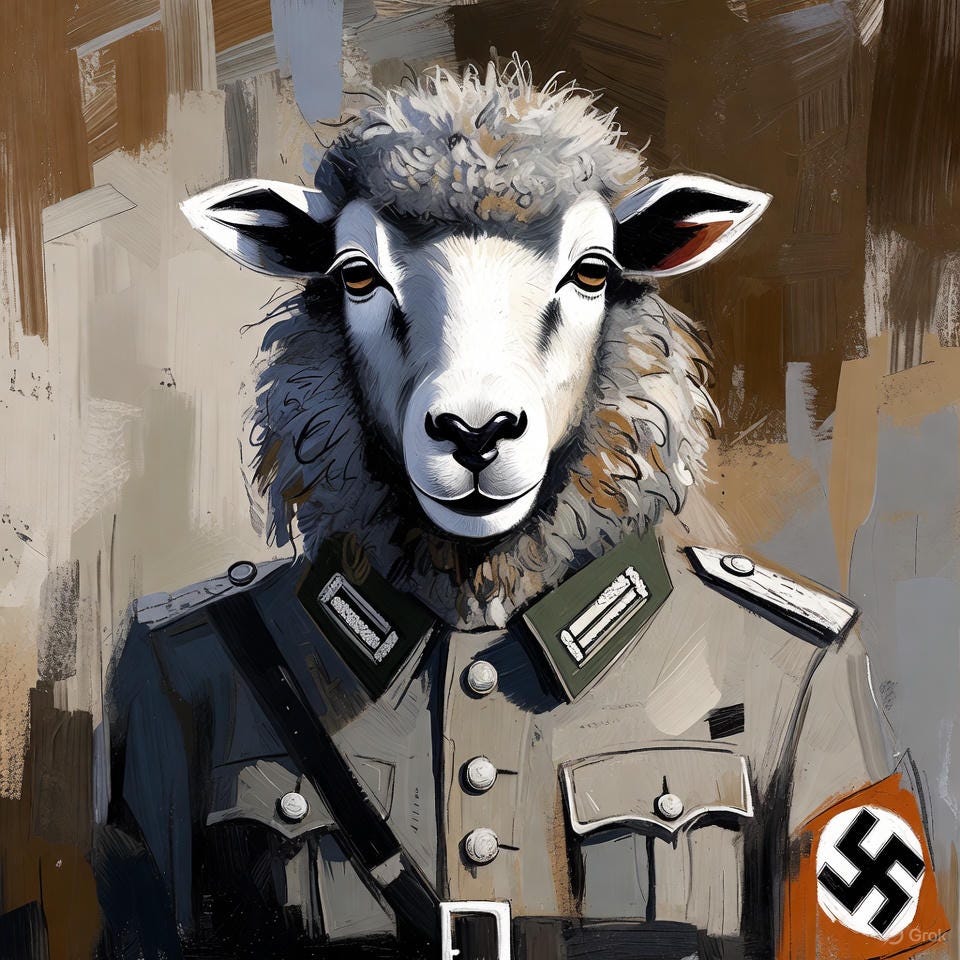
Now let’s talk about Nazis. Actual Nazis, not whoever it was politically convenient to hyperbolically call one today.
Nazis wanted to exterminate or enslave entire groups of people for idiotic reasons. Most morally functioning people today don’t just mildly “disapprove” of Nazis; they hate them. They don’t want Nazis marrying their kids, walking their dogs, or running their daycare. That’s good. That’s sane.
So imagine a classic trolley problem. You’re on a bridge. Next to you stands an unrepentant, giant, muscular Nazi who used to happily round up innocent people and put them on death trains. Down below: a runaway trolley headed straight for a car full of kittens. If you push the Nazi off the bridge, his body hits a switch and the trolley is diverted. He dies. The kittens live.
You should push him. Honorably.
If you don’t push the Nazi to save the kittens, I won’t say you deserve hell (no one does), but morally you’re failing badly. And if you fail because you’re afraid of being caught, or because your conscience has been poisoned by some ideology that tells you any act of violence is “impure” regardless of context, or because you’ve been trained to think hate is always wrong—then your “virtue” is unholy trash and hurting innocent kittens.
Hatred is on a spectrum. I can mildly dislike something, or I can loathe it with a passion, or anything in between. Haters of hate tend to be blind to this continuum. If you express a firm disagreement, they interpret it as genocidal rage.
If I say “I don’t believe trans women are women,” many people will infer I want violence against trans people, which is not true. I disagree with a metaphysical claim. I dislike being told I’m morally obliged to chant that claim. I also want trans people protected from harassment and actual violence. Refusing to adopt someone’s gender ideology is not violence, and refusing to affirm someone’s preferred pronouns is not harassment.
But some people will hate my disagreement and noncompliance so much that they want laws—backed by the threat of police, courts, and prison—to coerce my speech. I think trans women are male and trans men are female. I think using someone’s preferred pronouns is perfectly okay when it’s voluntary, but I also think it’s accurate to use he for males and she for females, and I have no interest in punishing anyone for “misgendering”—that is, not using biologically accurate pronouns.
There should be no government laws compelling pronoun usage. Not in private, and not for businesses. If you hate “hate” so much that you will use the violent arm of the state to punish someone for verbal noncompliance, you have more hate in your position than I do in mine. That alone doesn’t make you wrong. Sometimes more hatred is holy—like pushing Nazis off bridges to save kittens. But it should at least make you honest to yourself about what you’re doing.
That state violence also backs hate-speech laws, which are supposedly about stopping hate. How hypocritical. Advocating them is, by their own logic, hate speech. The laws are never applied to all hateful speech—they’re used selectively against certain kinds of hate, expressed by certain kinds of people. The same people who say they’re “fighting hate” will quite happily vomit hatred at their enemies and feel holy doing it.
The same dynamic plays out in institutions. If you’re in academia, or want to be hired there, it’s very clear that hate is a job requirement. Universities might as well be open about it and ask for “statements of hate”:
“I solemnly swear to hate people who reject racial and gender tribalism, and to hate people who decline to play the pronoun game.”
They’ll protest, of course: No, no, we love trans people; we don’t hate anyone; we’re allies. But “ally” is war language. In World War II, the Allies were those fighting the Axis. An “ally” presupposes an enemy. If an ally is caught fraternizing with the enemy, they’re no longer an ally. Being an ally requires hating the right people.
War is many things, but it is definitely not the absence of hate.
If you’ve been even slightly heterodox on this stuff in the last eight years—since the rise of The Dark Lord Trump and the ascendance of the new race-and-gender orthodoxy—you’ve probably felt the hatred of the haters of hate. Under very peculiar notions of “allyship,” people who didn’t display enough public zeal for the ideology were ostracized, ghosted, quietly un-friended. The marginalized were “allying” by marginalizing heretics.
A few good friends of mine—friends I discussed philosophy and politics with for decades—blocked me or cut off contact when they discovered I was a heretic. One reason? I don’t hate Trump enough. I have contempt for Trump, but I have at least as much contempt for Biden. That alone was sufficient to trigger their hatred. Hating “hate” wasn’t the problem; not hating their chosen villain hard enough was.
And then there’s “antisemitism.”
After Hamas’s massacre on October 7th and Israel’s catastrophic destruction of Gaza, there’s been an upsurge of hatred toward speech critical of Israel or Judaism. The rhetoric is all about opposing “antisemitism.” The people who hate “antisemitism” have rolled out the same style of control fantasy as those who dream of compelled pronouns: punish “hate.”
But very often what gets called “antisemitism” is hostility toward an ideology or political organization—Zionism, Judaism, the Israeli state—not racial hatred of Jews as a biological group. The category is often—sometimes deliberately—blurred.
Jews are not a race, any more than Christians or Scientologists are a race. Not all “Semites” are Jews; not all Jews are Semites. A Han Chinese person could become a Jew, Christian, or Scientologist without their race changing. Moral hatred of an ideology—Scientology, Nazism, Christianity, Islam, Judaism, Wokeism, Zionism—is not racism.
People know racism is socially and politically radioactive in the US. They don’t feel the same way about religious, political, or ideological antipathy. So it’s effective to slander someone as a racist for disliking an ideology or a political organization. Campaigns “against hate” exploit that confusion—especially around antisemitism.
Don’t misunderstand me: we absolutely should hate actual antisemites. The Nazis really did believe Jews were a “race” and hated that imaginary race murderously. They also hated almost every race that wasn’t their own. As I said, if a person pushes an unrepentant Nazi off a bridge to save a trolley full of kittens, they would be a hero. If they were punished for it, it would be a miscarriage of justice.
But given the power of the association between “antisemitism” and Nazism—and the very intense hatred everyone rightly feels for Nazism—accusing someone of antisemitism is a very loud call to viciously hate them. And the people making that accusation often revel in that hate while chanting slogans about “anti-hate.”
“Thou art an antisemite; thou hate.”
“Thou art a racist; thou hate.”
“Thou art a sexist; thou hate.”
“Thou art an Islamophobe; thou hate.”
“Thou art a transphobe; thou hate.”
It’s all the same structure. We could keep going with the logic:
“Thou art a Naziphobe; thou hate.”
“Thou art anti-Scientology; thou hate.”
“Thou art anti-communist; thou hate.”
“Hate” as a taboo word disintegrates under reason. It doesn’t disappear; it just loses its magic aura and you see it doing work as a tool of control. If someone passionately pushes “anti-hate” as a brand while constantly identifying, policing, and punishing the “haters,” chances are they are an aspiring tyrant. They don’t want to abolish hatred. They just want a monopoly on which hates are allowed.
A people without hate is a dream come true for a tyrant. Because without hatred, people will never dethrone them.
After all this talk of hate, what about love?
Love is never far from hate. Without loving something, we would hate nothing. Hatred is symbiotic with love. If you love your child, you will hate someone trying to torture your child. If you love truth, you will hate certain lies.
It’s like a coin: you can’t move heads without moving tails. The only way to get rid of hate is to get rid of love. And if that were somehow achieved—if you could anesthetize an entire society so they neither love nor hate anything—that would be an act of hate against what it means to be human.
People don’t go to war without loving something. Sometimes it’s something contemptible—love of a particular “race,” love of a sacred land that must be “cleansed” of other “races.” Sometimes it’s something decent—love of one’s friends, love of freedom. But there is always some love at stake. And behind that love, there is a shadow: a readiness to hate whatever threatens it. No amount of moralistic doublethink changes that.
Pushing the Nazi off a bridge to save the kittens is an act of love (for the kittens) and an act of hate (for the Nazi). Both are present. Both are necessary for that decision.We don’t make the world better by pretending hate is always evil. We make it better by being honest about what we love, what we hate because of that love, and what we’re willing—and not willing—to do in the name of either. The evil is never “hate” in the abstract.
The evil is in the details.


How Anti-Zionism Became Antisemitism

History provides an unambiguous definition of antisemitism, yet its meaning has been distorted for ideological ends.
Capitalism Isn’t Responsible for Society’s Flaws; You Are

If we want a better world, we have to start wanting better.

Excellent post. Thank you. Whenever I see the signs posted in front of houses that say "hate has no home here", I chuckle because I know they actually hate people who disagree with their political views.
Sometimes I read an article I think should be broadcast everywhere until people actually comprehend it's content. This is definitely one of them. I felt like I had been waiting for someone to say this. If not merely to share this view it seems few ever think about, then at least to know someone can sift out the meaningful nuance without tripping on all of the triggers this topic carries.
Thank you for wrighting this.
I loved it.